Showing posts with label Skin Conditions. Show all posts

Wednesday, 11 March 2015

Do you get unsightly little white bumps under your skin, on areas of your face?

They usually look pearly white or yellowish little balls 1 to 2 mm in diameter and tend to show up around the eye area, on the cheeks, and around the jaw; however they can appear anywhere.
Milia Skin Condition

Many people believe them to be white heads or pimples and try to remove them with acne skin care, or by squeezing, without success.  This is because they are not pimples they are Milia (Milium is the singular of Milia).

What is Milia


Milia are dead skin cells or keratine trapped beneath the skin's surface. Babies and infants tend to get Milia because their skins do not yet know how to exfoliate. Milia are harmless and in infants they disappear by themselves within a few weeks.

In adults, Milia can be primary or secondary. Primary Milia are caused by dead skin cells that did not exfoliate properly, they can also be caused by genetic disposition. Secondary Milia are caused by burns, skin infections, rashes and exposure to the sun.

How to treat Milia

Milia often go away by themselves, however in adults it can take months and even years for them to disappear. It is important that you do not try to extract them  yourself because squeezing and poking can cause damage to the surrounding skin and leave a scar.

The dermatologist or skin specialist can use a lancet or needle to gently pierce the skin and push out the contents, it doesn't require anesthetic.

If the Milia is extensive the skin specialist may recommend chemical peels, Cryotherapy, Laser, topical Retinoid cream, or Dermabrasion.

How to prevent Milia

To prevent Milia it is important to follow a skin care routine, use daily sunscreen, and exfoliate regularly.

More Information

http://www.patient.co.uk/health/milia-leaflet
http://www.skinsight.com/adult/milia.htm
http://www.paulaschoice.com/expert-advice/skin-disorders/_/milia

Sunday, 5 October 2014

What is Rosacea? and ... Is it affecting you?


www.rosacea.org
Most people don't know what Rosacea is. Many people even have it without knowing. So what is Rosacea?

Rosacea is a skin condition that affects mainly people of north-western European descent, however it is found on all segments of the population. It usually starts with sporadic blushing or flushing of the face. Overtime the redness becomes more persistent and intensifies. Red bumps like pimples and broken capillaries may develop. In severe cases the eyes can get irritated and bloodshot and the nose may grow swollen and bulbous from excess tissue.

Regrettably there is no cure for Rosacea and its causes are unknown. There are, however a number of treatments to reduce the symptoms and keep the condition in check. Early diagnosis is recommended because if left untreated it worsens over time.

Rosacea develops primarily on people between the ages of 30 and 60 and affects more women than men.

There are 4 subtypes and most people develops symptoms of more than one subtype:

Rosacea Subtype 1 - Erythematotelangiectatic Rosacea

This subtype is characterised by permanent redness, the skin can become dry and flaky, there is frequent blushing and there can be a burning sensation. Often capillaries close to the surface of the skin dilate and become visible.

Rosacea Subtype 2 - Papulopustular rosacea

Characterised by permanent redness and transient red bumps, sometimes with pus. It is often confused with acne.

Rosacea Subtype 3 - Phymatous rosacea

In this subtype the skin thickens, specially in the area of the nose, although it also appear in the forehead, chin, cheeks, ears and eyelids. There can be some nodularities and enlargement due to excess skin, small broken capillaries can also be visible.

Rosacea Subtype 4 – Ocular Rosacea

The eyes are often dry, itchy, red and watery. The eyelids are also irritated and swollen, and often develop cysts. This condition can cause vision loss due to corneal damage.

What causes Rosacea?

Although the exact cause of Rosacea is unknown there are many trigger factors that increase blushing and may play a part in the development of Rosacea:

- exposure to extreme temperatures or quick changes in temperature
- wind
- strenuous exercise
- sun exposure
- caffeine
- drinking alcohol
- spicy foods
- some vegetables and fruits
- dairy products
- hot baths
- some cosmetics and harsh skin care products
- humidity
- medical conditions and some medications
- stress and anxiety
- Demodex mite

How to manage Rosacea

While there is no cure for the condition a number of treatments can control or reverse some of the symptoms. It is also important to avoid trigger factors and use gentle skin care products.

Rosacea is very individual dependant, so treatments and products have to be tailor to the individual patient. A treatment that may work very well for one person may not work for another.

Antibiotics as well as number of drugs are available to treat the condition. It is important to consult your doctor or dermatologist to get a diagnosis and any prescription medicines you may require.


For mild eye irritation or dryness artificial tears, and the daily cleansing of the eyelashes with a mild shampoo may be recommended.

In the case of Rosacea Subtype 3, surgery may be required to remove excess skin.

Monday, 7 April 2014

Head Mites - They can be the cause of your hair loss

Like many women over 40 and 70% of men, my hair has started to thin out on the top.

Actually that is not quite accurate. There is an area on the top/back of may head where the hair has been thinner than the rest since I was a teenager. My hair is naturally thick and abundant so it was not so noticeable. When I consulted a dermatologist, she sent some blood tests asked questions about my parents and grand parents hair and concluded that it was unlikely that it would extend and that the only treatment that worked for such conditions was taking some hormone medication that she didn't recommend because of side effects.

My hair remained unchanged for many years, but now the thinning out has extended to the top of my head. I still don't like the idea of taking hormones, so after an acquaintance recommended it because it had given her great results, I have started using Environ's Intensive Hair & Scalp Tonic. I still cannot talk about results because it has been only a few weeks and most of those treatments take a few months to start showing results.
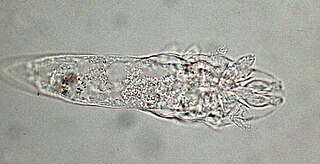
http://upload.wikimedia.org/wikipedia/commons/thumb/8/8c/Demodex-whole-mite.jpg/320px-Demodex-whole-mite.jpg
Demodex Mite - Photography by Alan R Walker

A couple of weeks ago, I was at the Salon Expo in Melbourne and because I was keeping my eyes open about anything to do with hair loss treatments, I came across a stand that claimed that hair loss could be caused by a microscopic mite that lives in our pores eating sebum.

I didn't quite believed it because I thought if it were true I would have heard of it by now. I seems I was wrong.

There are two species of head mites or Demodex that live on humans:  Demodex Folliculorum and  Demodex Brevis. They pass most of their time with their heads burrowed into our hair follicles. They are mostly found on our faces: cheeks, chin, nose, eyelids and forehead; however, they can live in any part of our skin.

Demodex prefer oily skin and their numbers increase in the summer months. They have a clawed mouth (palpus organ) and eat the sebum in our pores as well as the cells that line the inside of our follicles.

Only a small percentage of kids have Demodex, but by the time you are 80 there is an 80% chance that you will have Demodex. They are also more abundant in people with immune system deficiencies or that are taking drugs that affect their defences.

It is believed that Demodex activity, either directly or indirectly, may be the cause of many skin affections such as rosacea, acne and hair loss. There are very few studies and although there are many products that claim to kill Demodex, reviews are mixed.

Here is a list of links to products and home recipes that may help eliminating or controlling Demodex:

Tea Tree Oil
Kwellada
ZZ Cream
Sea Buckthorn Oil