Showing posts with label Acne. Show all posts

Wednesday, 11 March 2015

Do you get unsightly little white bumps under your skin, on areas of your face?

They usually look pearly white or yellowish little balls 1 to 2 mm in diameter and tend to show up around the eye area, on the cheeks, and around the jaw; however they can appear anywhere.
Milia Skin Condition

Many people believe them to be white heads or pimples and try to remove them with acne skin care, or by squeezing, without success.  This is because they are not pimples they are Milia (Milium is the singular of Milia).

What is Milia


Milia are dead skin cells or keratine trapped beneath the skin's surface. Babies and infants tend to get Milia because their skins do not yet know how to exfoliate. Milia are harmless and in infants they disappear by themselves within a few weeks.

In adults, Milia can be primary or secondary. Primary Milia are caused by dead skin cells that did not exfoliate properly, they can also be caused by genetic disposition. Secondary Milia are caused by burns, skin infections, rashes and exposure to the sun.

How to treat Milia

Milia often go away by themselves, however in adults it can take months and even years for them to disappear. It is important that you do not try to extract them  yourself because squeezing and poking can cause damage to the surrounding skin and leave a scar.

The dermatologist or skin specialist can use a lancet or needle to gently pierce the skin and push out the contents, it doesn't require anesthetic.

If the Milia is extensive the skin specialist may recommend chemical peels, Cryotherapy, Laser, topical Retinoid cream, or Dermabrasion.

How to prevent Milia

To prevent Milia it is important to follow a skin care routine, use daily sunscreen, and exfoliate regularly.

More Information

http://www.patient.co.uk/health/milia-leaflet
http://www.skinsight.com/adult/milia.htm
http://www.paulaschoice.com/expert-advice/skin-disorders/_/milia

Monday, 7 April 2014

Head Mites - They can be the cause of your hair loss

Like many women over 40 and 70% of men, my hair has started to thin out on the top.

Actually that is not quite accurate. There is an area on the top/back of may head where the hair has been thinner than the rest since I was a teenager. My hair is naturally thick and abundant so it was not so noticeable. When I consulted a dermatologist, she sent some blood tests asked questions about my parents and grand parents hair and concluded that it was unlikely that it would extend and that the only treatment that worked for such conditions was taking some hormone medication that she didn't recommend because of side effects.

My hair remained unchanged for many years, but now the thinning out has extended to the top of my head. I still don't like the idea of taking hormones, so after an acquaintance recommended it because it had given her great results, I have started using Environ's Intensive Hair & Scalp Tonic. I still cannot talk about results because it has been only a few weeks and most of those treatments take a few months to start showing results.
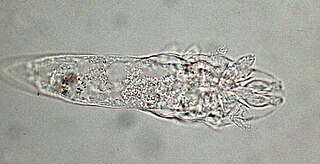
http://upload.wikimedia.org/wikipedia/commons/thumb/8/8c/Demodex-whole-mite.jpg/320px-Demodex-whole-mite.jpg
Demodex Mite - Photography by Alan R Walker

A couple of weeks ago, I was at the Salon Expo in Melbourne and because I was keeping my eyes open about anything to do with hair loss treatments, I came across a stand that claimed that hair loss could be caused by a microscopic mite that lives in our pores eating sebum.

I didn't quite believed it because I thought if it were true I would have heard of it by now. I seems I was wrong.

There are two species of head mites or Demodex that live on humans:  Demodex Folliculorum and  Demodex Brevis. They pass most of their time with their heads burrowed into our hair follicles. They are mostly found on our faces: cheeks, chin, nose, eyelids and forehead; however, they can live in any part of our skin.

Demodex prefer oily skin and their numbers increase in the summer months. They have a clawed mouth (palpus organ) and eat the sebum in our pores as well as the cells that line the inside of our follicles.

Only a small percentage of kids have Demodex, but by the time you are 80 there is an 80% chance that you will have Demodex. They are also more abundant in people with immune system deficiencies or that are taking drugs that affect their defences.

It is believed that Demodex activity, either directly or indirectly, may be the cause of many skin affections such as rosacea, acne and hair loss. There are very few studies and although there are many products that claim to kill Demodex, reviews are mixed.

Here is a list of links to products and home recipes that may help eliminating or controlling Demodex:

Tea Tree Oil
Kwellada
ZZ Cream
Sea Buckthorn Oil